How water actually gets into a home here
Orange County homes sit on concrete, not basements. That changes what fails, where the water goes, and how long it runs before anyone sees it.
- 1 AC condensate. The pan overflows up in the attic and finds the ceiling below it.
- 2 The ceiling stain. It marks where the water arrived, not where it started out.
- 3 A burst supply line. Pressurized pipe inside a wall, running until the main is shut.
- 4 The water heater. Often in the garage, and its failure runs toward the house, not away from it.
- 5 A slab leak. It travels sideways under the concrete and surfaces long after it began.
Start with what you are seeing
- Slab leak A warm patch on a tile or concrete floor, usually in one spot
- Slab leak detection You already know there is a leak but not where
- Slab leak repair A leak has been located and you are choosing how to fix it
- Water heater leak Water pooling around the base of the tank
- AC water leak A brown ring or sagging spot on a ceiling, often near a hallway or closet
- Ceiling water damage A brown or yellow ring that is still growing at the edges
- Burst pipe Water appearing quickly from a wall, ceiling or under a cabinet
The pattern behind all seven
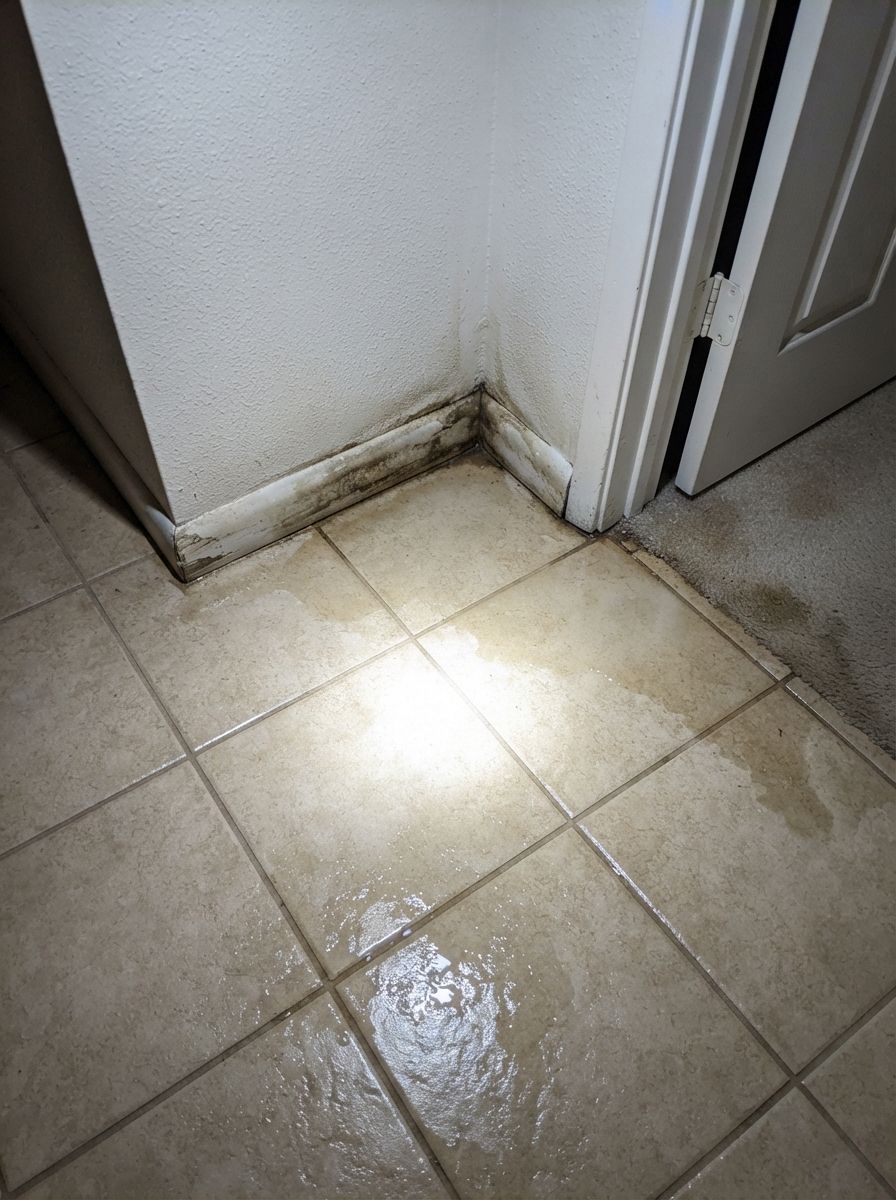
In a home with a basement, water announces itself: it collects somewhere you can stand and look at it. On a slab, it does the opposite. It moves sideways through soil, sits inside wall cavities, spreads across ceiling insulation, and surfaces somewhere other than where it started.
That is why the useful question is rarely "how much water is there." It is "how long has it been there, and what has it already reached."
Water damage restoration in Orange County · Mold inspection and testing