Slab leaks in Orange County homes
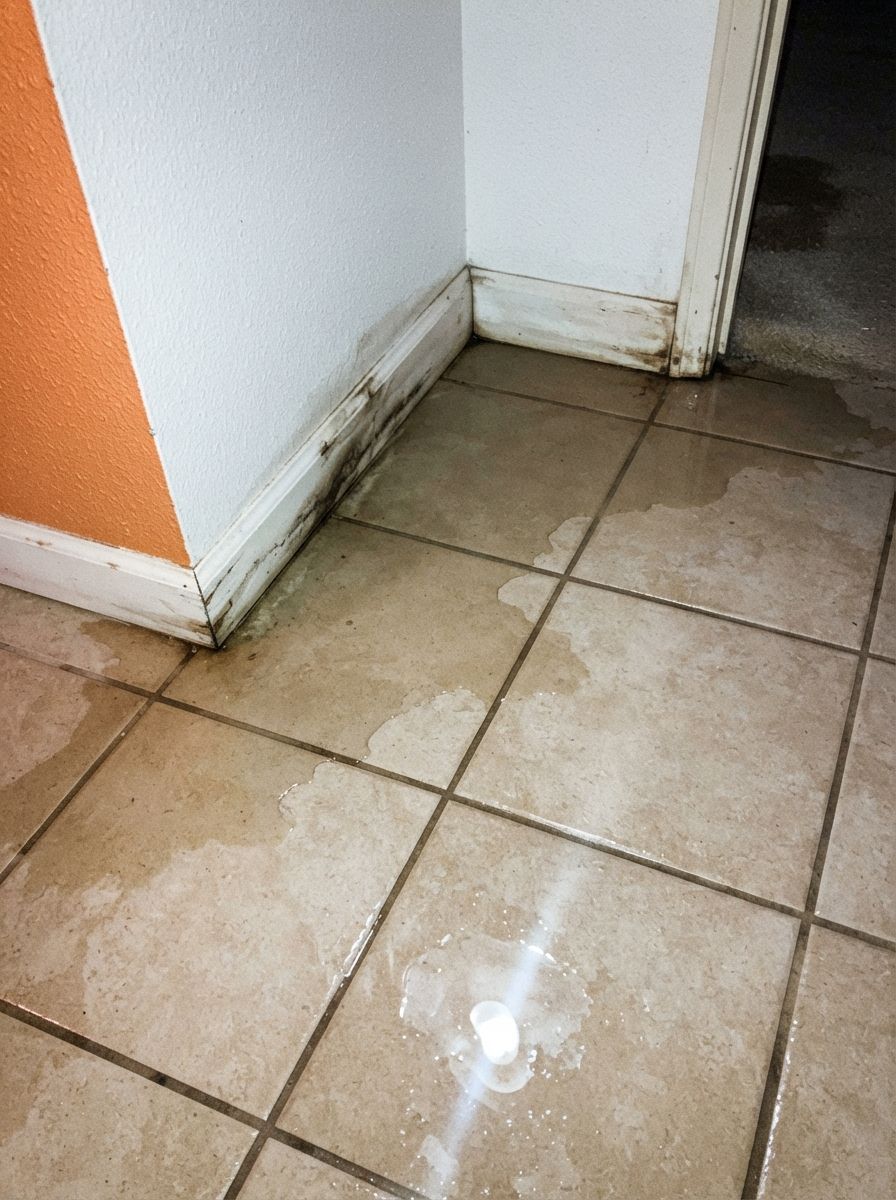
Almost every home in Orange County sits on a concrete slab, with the water supply running underneath it. When one of those lines fails, the water has nowhere obvious to go, so it goes into the ground, into the slab, and eventually into your flooring.
Signs to look for
- A warm patch on a tile or concrete floor, usually in one spot
- A water bill that climbed with no change in how you use water
- The sound of running water when everything is shut off
- Flooring that lifts, cups or separates in one area
- A damp or musty smell near the floor that will not go away
- Cracks appearing in tile grout or drywall as the slab shifts
Several of these signs also fit something above the slab, and one free check separates them better than a list can. The slab leak check asks what you are seeing, what the water meter does with everything shut off, and where the sign sits.
- 1 AC condensate. The pan overflows up in the attic and finds the ceiling below it.
- 2 The ceiling stain. It marks where the water arrived, not where it started out.
- 3 A burst supply line. Pressurized pipe inside a wall, running until the main is shut.
- 4 The water heater. Often in the garage, and its failure runs toward the house, not away from it.
- 5 A slab leak. It travels sideways under the concrete and surfaces long after it began.
Why they run for so long before anyone notices
A leak in a wall shows itself. A leak under six inches of concrete does not. The water saturates the soil beneath the slab first, then works sideways until it finds an edge: a joint, a crack, the perimeter of the foundation.
By the time it reaches something you can see, it has usually been running for weeks. That is the part homeowners find hardest to accept: the damage is not from today, it is from everything that happened before today.
What causes them here
Copper supply lines rubbing against concrete as they expand and contract, decades of it, until the wall of the pipe wears through. Soil chemistry that corrodes copper from the outside. And in homes from the 1960s and 1970s, original lines that have simply reached the end of their service life at the same time as their neighbors.
Which is why these calls arrive in clusters rather than one at a time. The tracts through Garden Grove and Santa Ana were plumbed within a few years of each other and are working through the same decade together, while the newer ground out toward Irvine is a generation behind on the same clock. A neighbour who has just had a slab opened is information about your own house.
Fixing the source is only half of it
Repairing the line stops the water. It does not dry what the water already reached: the subfloor, the flooring adhesive, the base of the drywall and whatever is behind the baseboards. That part is restoration work, and it is what determines whether mold shows up three weeks later.